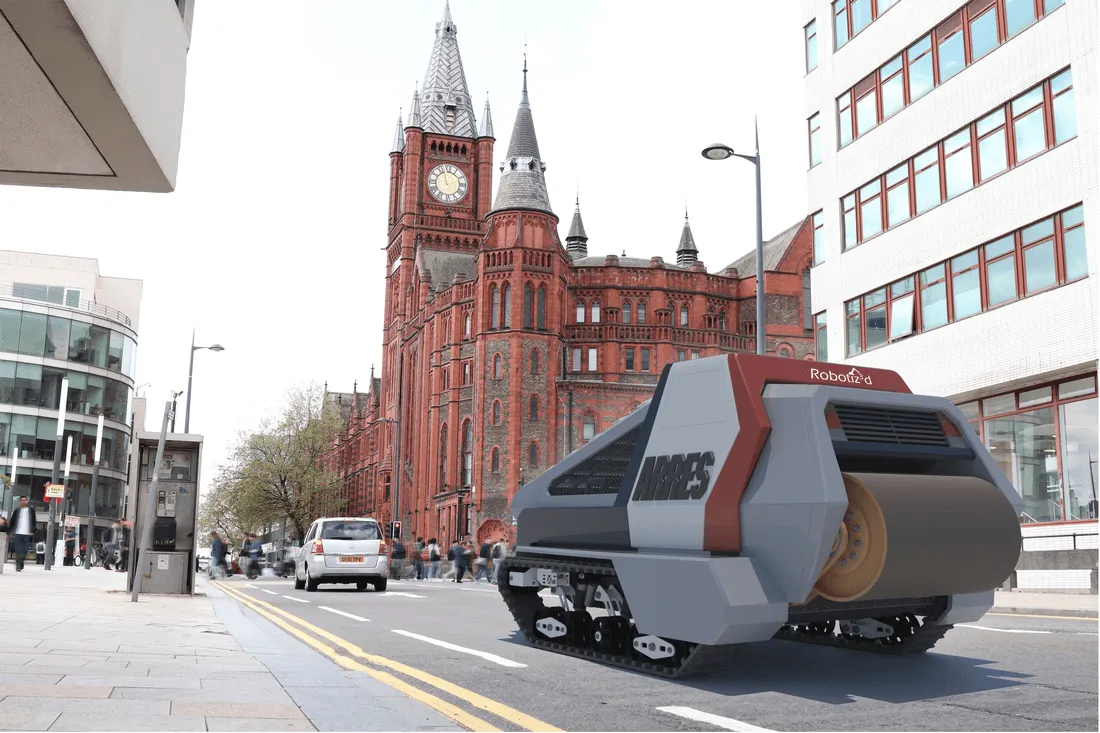
Robotiz3d: Autonomous Road Maintenance
Autonomous robots with artificial intelligence identifying and repairing cracks and potholes.
Challenge
Robotiz3d is building an autonomous road maintenance system that can identify and repair cracks and potholes in the road surface by itself. The solution uses profilometry to create a 3D point cloud representation of the road surface to identify defects and then directly fix these in one working process.
Robotize3d are experts on robotics but did not have the expertise with Artificial intelligence to actually process the information from the sensor to detect actual defects in the road surface that could be repaired. That is why they reached out to us for help.
Solution
Since this was a novel application of Machine Learning the first step was for Robotize3d to use the sensor to collect and label training data that we could use to train the model. Initially, we worked on a 3D point cloud representation of the road surface, However, it became evident that since the detector function was very similar to a scanner, i.e., all the point clouds were rectangular, we could use an image representation instead.
By moving to an image representation we could utilize a computer vision technique called semantic segmentation to solve the problem instead. Going from a 3D point cloud representation that our client initially wanted to the image representation resulted in a 25x speedup in processing speed while also boosting the performance.
Top-down road scan. The model segments each pixel as crack, pothole, or intact asphalt.
Press “Scan road” to run the detector.
Detection is only half the job: to repair a pothole the robot needs to know how much material to dispense. The profilometry sensor returns a 3D point cloud of each defect, and integrating its depth over the scanned surface gives the void volume, and from that the exact mass of asphalt to fill it.
Profilometry point cloud of the pothole. Drag to rotate. Colour shows depth below the road plane.
Integrating depth over the scanned surface gives the void volume; multiplying by cold-mix density (≈ 2.3 kg/L) gives the material the robot dispenses. Illustrative.
Business Value
With the addition of our robust deep vision technology, it was possible for Robotize3d to make their autonomous road maintenance vehicle become a reality. With this new product on the market, it will be possible to service roads faster, cheaper, and with less man power.